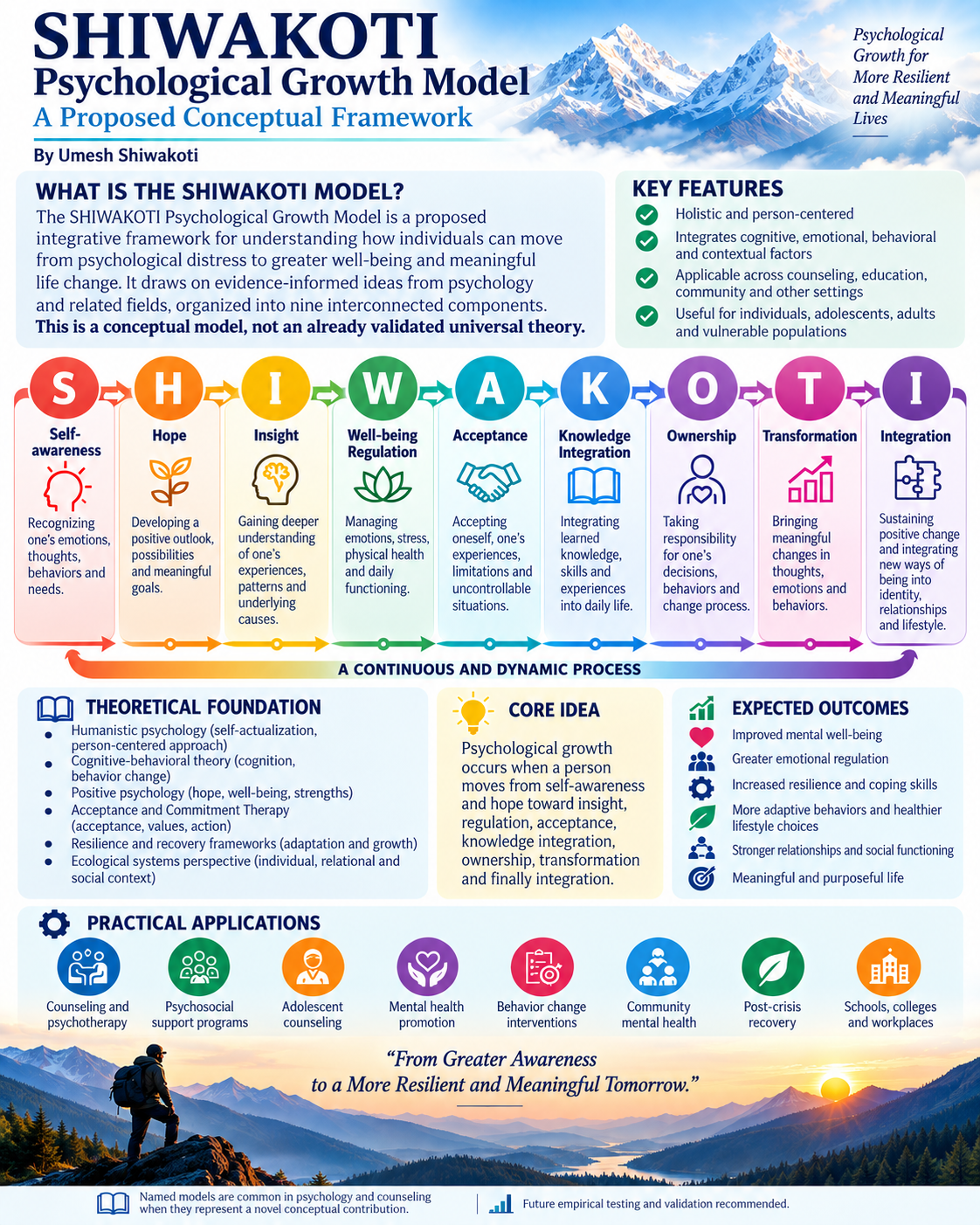
A Proposed Conceptual Framework
By Umesh Shiwakoti
How free should the human mind be?
At first, this may sound like a philosophical question. But when we think more deeply, it becomes a psychological, ethical, social, and legal question as well.
A person may feel anger, hatred, jealousy, revenge, or even imagine harming someone. Human beings do not always have pleasant thoughts. Sometimes thoughts appear suddenly, sometimes they come during emotional pain, and sometimes they are only temporary reactions.
But having a thought is not the same as having an intention.
And having an intention is not always the same as taking action.
This difference is very important.
If society starts treating every disturbing thought as a danger, then people may lose something very basic: the freedom to think, feel, question, imagine, and struggle internally without being judged as criminals.
At the same time, there is another side to the issue.
What happens when a thought is no longer just a thought?
What happens when anger becomes a clear intention, intention becomes planning, and planning starts moving toward real harm?
At that point, society also has a responsibility to protect other people.
This creates a difficult but important question:
Where should freedom of mind end when the safety of others begins to be seriously threatened?
This question is the foundation of the idea I call Freedom of Mind vs Collective Safety.
The purpose of this concept is not to control people’s minds.
It is also not to justify unnecessary interference in personal thoughts or emotions.
Its purpose is to explore how individual psychological freedom and the safety of society can be understood together, without sacrificing one completely for the other.
A Thought Is Not a Crime
Human beings often think things they never act upon.
A person may say, “I was so angry that I felt like hurting him.”
This statement may express intense emotion, but it does not automatically mean that the person is going to commit violence.
People can experience unwanted, frightening, or aggressive thoughts without wanting them to become reality.
This is why thoughts should not be treated as actions.
If we fail to make this distinction, we risk creating a society where people are judged not for what they do, but for what passes through their minds.
That would be dangerous.
Freedom of mind is closely connected with dignity, individuality, privacy, creativity, and personal growth.
A person must be allowed to think, reflect, doubt, feel, and even experience difficult emotions without automatically being treated as a threat.
But Freedom Cannot Ignore Real Danger
There is also a point where society cannot simply say, “It is his personal freedom.”
If there is clear evidence that someone is moving from a private thought toward a serious intention to harm others, the situation changes.
The question is no longer only about personal freedom.
It also becomes a question of responsibility, prevention, and protection.
This is where the debate becomes difficult.
If society intervenes too early, it may violate personal freedom.
If society intervenes too late, a preventable tragedy may occur.
So the real challenge is not choosing freedom or safety.
The challenge is finding a fair balance between them.
Two Different Dangers
There are two opposite dangers in this discussion.
The first is over-intervention.
When society becomes too suspicious of people’s thoughts, emotions, beliefs, or private struggles, there is a risk of stigma, discrimination, false judgment, and unnecessary restriction of personal freedom.
A person should not lose rights simply because he or she is angry, emotionally disturbed, unpopular, unusual, or thinks differently from others.
The second danger is under-intervention.
Sometimes warning signs are visible, but they are ignored until serious harm occurs.
In such cases, complete inaction can also become a failure.
This creates a difficult balance:
Too much intervention may harm freedom.
Too little intervention may harm safety.
A responsible society must think seriously about both.
The Difference Between Thought and Movement Toward Action
One of the most important ideas behind this framework is simple:
Thought, intention, planning, and action are not the same psychological state.
There is a major difference between:
“I hate him.”
and
“I want to harm him.”
There is also a difference between:
“I want to harm him.”
and
“I have decided when, where, and how I will do it.”
These differences matter.
The closer a person moves toward actual harmful behavior, the stronger the concern for safety may become.
But the existence of a disturbing thought alone should never automatically be treated as proof of future action.
This distinction may help create a more balanced way of thinking about psychological freedom and public protection.
Why This Debate Matters
Modern society is becoming more concerned with prediction, risk, prevention, and security.
We often want to know what may happen before it happens.
This can be useful, but it can also become dangerous if prediction is treated as certainty.
Human beings are complex.
People change their minds.
Emotions pass.
Intentions can weaken.
Circumstances change.
A person who feels extreme anger today may feel completely different tomorrow.
Because of this, psychological judgment must be careful.
We should never confuse possibility with certainty.
At the same time, serious and credible signs of possible harm should not be ignored simply because no action has yet occurred.
This is the tension that this framework tries to explore.
A Question for Psychology, Law, and Society
This is not only a psychological issue.
It is also a question for law, ethics, human rights, education, counseling, criminology, and public policy.
A counselor may face a situation where a client expresses violent thoughts.
A teacher may hear a student make a threatening statement.
A family may notice that someone’s anger is becoming more serious.
A community may see warning signs but may not know when concern becomes real danger.
In all of these situations, one question remains:
When does respecting an individual’s inner freedom become less important than protecting others from a serious and credible threat?
There may never be one simple answer for every situation.
But the question itself deserves serious discussion.
The Need for Balance
A healthy society should not be built on fear.
It should not monitor or punish people simply because of their private thoughts.
At the same time, a healthy society should not ignore clear movement toward serious harm.
The goal should be balance.
Not control.
Not silence.
Not unnecessary restriction.
And not careless inaction.
The aim should be to protect the freedom of the individual while also recognizing the rights and safety of others.
That is the central idea of Freedom of Mind vs Collective Safety.
Final Thought
Human freedom becomes meaningful when people are allowed to think, feel, question, and struggle without fear of being judged for every thought.
But freedom also exists within a society where other people have the right to live safely.
So perhaps the real question is not:
“Should we choose freedom or safety?”
The better question may be:
“How can we protect both, and where should the boundary between them be drawn?”
That boundary deserves deeper psychological and social discussion.
Respect the freedom of the mind.
Protect the safety of life.
Seek balance between liberty and responsibility.
Freedom of Mind vs Collective Safety
A Proposed Conceptual Framework
By Umesh Shiwakoti